Next-Generation Autonomous Intelligence & Knowledge Retrieval.
Answers retrieved from your own documents with citations, a clear refusal when the answer is not there, and agents that act only through governed APIs. Built on Microsoft Foundry and Copilot Studio in your tenant, with an evaluation harness that proves it works before your team relies on it.
- 13AI service linesuse-case selection to managed support
- 7Pipeline stages scoredingest → evaluate, every change
- 10–14 wksFirst use case to productionlater use cases are faster
- < 24 hrReply to every enquiryscoping call inside a week
You probably need this if —
- The demo impressed everyone and then stopped
- It answers confidently and sometimes wrongly
- Nobody can prove whether a change made it better
- Security will not sign off on the pilot
- Four teams are building four different bots
- Copilot can answer, but it cannot do anything











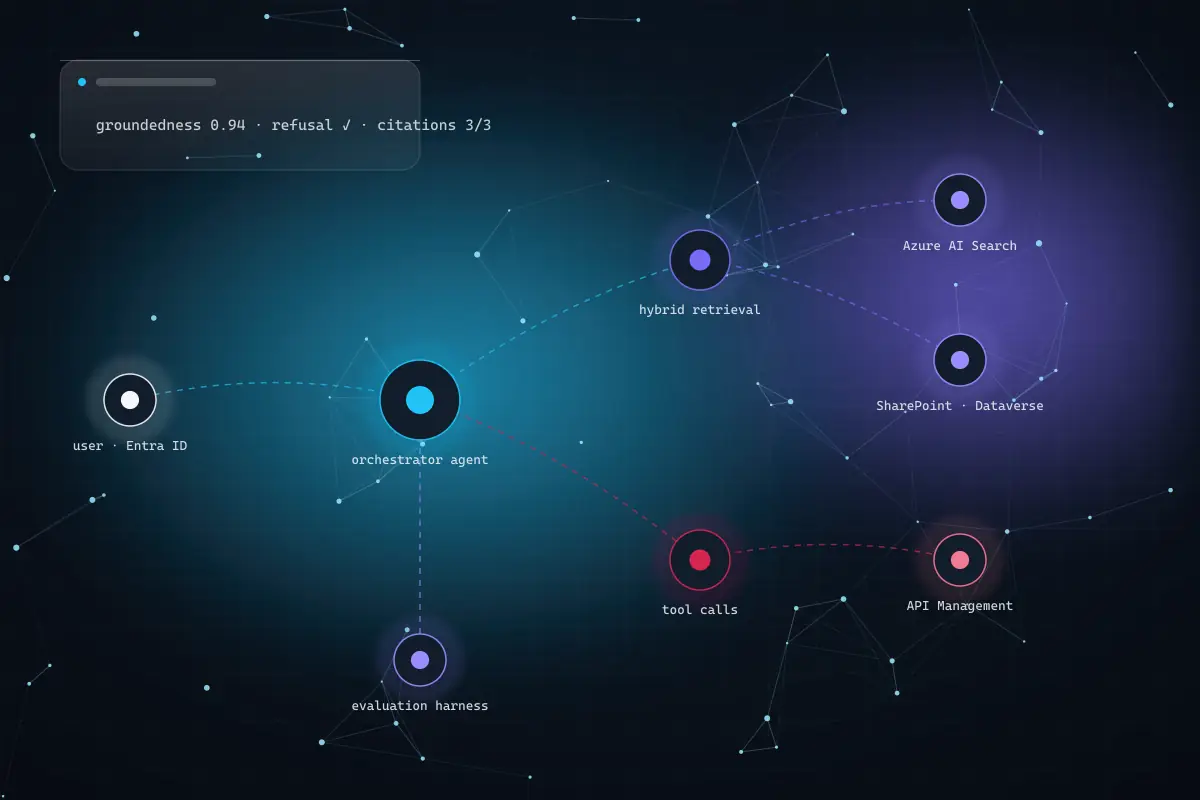
"It hallucinates" is almost never a model problem.
It is a retrieval, permission or evaluation problem, and it happens at a specific node. Hover any node to see the stack and protocols behind it, then watch a real run in the execution console.
Live simulated agent execution
Query routing, permission-trimmed vector search, reranking, grounded generation with citations and the evaluation gate — including the run where the correct answer is to decline.
Every AI service, under one accountable engagement.
Take the whole programme or one use case. Each capability below is here because we have seen projects fail without it.
- 01
Multi-Agent Orchestration
Copilot Studio and Microsoft Foundry agents with tool use, multi-step planning, memory where it helps and a defined escalation path to a person. Business-facing agents in Copilot Studio; the custom retrieval platform behind them in Foundry.
- Foundry Agent Service · Copilot Studio · MCP tools
- Human-in-the-loop approval for expensive actions
- Named owner and per-action audit trail
- 02
Vector Database Architecture
Azure AI Search with hybrid keyword-and-vector retrieval, structure-aware chunking and permissions carried through ingestion. The index cannot return a passage the requesting user could not already open.
- Hybrid BM25 + HNSW with semantic reranking
- ACL and sensitivity-label trimmed filters at query time
- Scheduled re-embedding as content changes
- 03
Real-Time Enterprise RAG
Ingest, chunk, embed, retrieve, rerank, ground and evaluate — the seven stages that decide whether answers are trustworthy. Generation is constrained to retrieved passages, with citations and an explicit instruction to decline.
- Citations users can check, refusal scored as success
- Model per task with caching and cost per interaction
- Content readiness: duplicates and stale versions resolved first
- 04
Custom LLM Fine-Tuning
Used where it earns its place: a consistent tone at scale or high-volume classification where latency and cost matter. Fine-tuning teaches style, not facts — so we measure the RAG baseline first and fine-tune only when the harness says it helps.
- Azure OpenAI fine-tuning with held-out evaluation
- Prompt engineering and few-shot before weights
- Model upgrades regression-tested against the golden dataset
- 05
Guardrails & Safety Protocols
Content filtering, prompt-injection and jailbreak testing, PII detection and redaction, output validation and an acceptable-use policy people have read. Tested adversarially, documented for the EU AI Act and ISO/IEC 42001 where they apply.
- Azure AI Content Safety · prompt shields
- AI risk register and human oversight model
- Disclosure, logging and incident path built in
- 06
API Middleware
Agents connected to line-of-business systems through governed APIs, Microsoft Graph and Azure integration services. Each new agent becomes a policy change on an existing gateway — throttled, authenticated, logged and revocable in one place.
- Azure API Management tool surface with OAuth 2.0
- Idempotency keys so a replayed action cannot double-post
- Service Bus events for asynchronous work
Use cases that reach production, by industry.
Narrow, measurable, and answering from content that already exists. Each one is tracked against a metric someone in the business already cares about.
01 · problem statement
Financial services
Policy and compliance questions answered from memory, contract review queued behind a small legal team, and a regulator who expects evidence for every answer given to a client.
02 · deployed architecture
Permission-trimmed RAG over policy, procedure and playbook libraries with clause-level citations; a contract-triage agent that flags non-standard clauses against the playbook and routes to legal with differences highlighted, not summarised away.
- Microsoft Foundry
- Azure AI Search
- Copilot Studio
- Purview labels
- API Management
03 · what we measure
- Clause-cited answers
- % of responses
- citation validity scored on every change
- Contract triage cycle
- hours per contract
- median and worst case, before and after
- Refusal correctness
- % declined correctly
- declining when the answer is absent is a success
We publish the metrics we baseline and report against, not headline percentages. Results are measured in your tenant against a two-week pre-deployment baseline and reported monthly, including the months where a number did not move.
What a grounded assistant is worth to your team.
Your inputs, our arithmetic. Move the sliders to the numbers you believe, and treat the result as a hypothesis to baseline — not a promise.
your estimate · per year
estimated value of hours returned, per year
- Hours returned per year
- 5,520
- FTE-equivalent capacity
- 3.2
Assumes 46 working weeks and 1,700 productive hours per FTE. Azure and model consumption bills from Microsoft to your own subscription and is not included. This calculator publishes the arithmetic; it does not forecast your outcome.
Baseline this with usThree ways to work with us.
Not sure which fits? The free scoping call ends with a recommendation, including the case for not building anything yet.
- Start here · free01
AI scoping call
Forty-five minutes on your use case: whether it is a retrieval, agent or content problem, what your data readiness actually looks like, and whether it can reach production. Nothing to install, no obligation, and the assessment is yours to keep.
- Commitment
- None
- Turnaround
- Inside a week
- You receive
- Feasibility read
- Fixed-price project02
First use case to production
One use case taken from scoping through harness, build, pilot and production, priced against an approved scope. Best where you need a proven result before committing to a wider programme.
- Priced
- After scoping
- Change control
- Written, agreed
- Suits
- Proving it once
- Retainer03
Managed AI
Scheduled evaluation runs, index refresh, model upgrades regression-tested before they land, cost review, guardrail updates and an SLA-backed desk. On systems we built and systems we inherited.
- Term
- Rolling, 30-day exit
- Reporting
- Quality & cost, monthly
- Suits
- Live systems, no AI owner
We do not publish rate cards, because a number without your use case and your content behind it is guesswork someone eventually has to walk back. What we publish is the method: scope first, fix the price second, deliver against it third. Azure and model consumption is billed by Microsoft directly to your own subscription and never resold through us. Microsoft MCI and ECIF partner funding may cover part of the work where you qualify.
What clients say about the AI agents we have built.
Feedback from teams running Congnivex-built RAG systems and agents in production, and an illustration of the engineering change that gets a stalled proof-of-concept signed off.
“The RAG system they built actually cites its sources. That alone got it past our legal review.”
Before & after: the stalled POC
- Answer quality
- Scored on every change
- golden dataset · regression gate
- Permissions
- Trimmed at query time
- the reason security signs off
- Wrong answers
- Cited, or declined
- refusal scored as a success
- Token spend
- Model per task, cost per interaction
- where the business case is won
Illustrates the engineering change on a typical inherited proof-of-concept, not a client’s figures. Measured outcomes are reported against your own baseline.
Verification & alignment
- Microsoft Solutions Partner — Data & AIpartner
Designation earned on measured delivery performance and certified staff.
- Microsoft Solutions Partner — Modern Workpartner
Co-sell partner; eligible projects may be part-funded through MCI and ECIF.
- EU AI Act · ISO/IEC 42001compliance
Governance documentation aligned to both where they apply to you — built into the engagement, not retrofitted.
- Privacy Act · DPDP Act 2023 · DIFC/ADGMcompliance
Residency in Australia East, India regions or UAE North; your data is never used to train Microsoft or OpenAI models.
- Evaluation harness on every changepractice
Accuracy, groundedness, refusal and citation validity scored before anything ships.
- Your tenant, your code, your datapractice
No proprietary Congnivex runtime; consumption bills from Microsoft to your subscription.
AI agents and RAG, answered.
The questions we are asked in almost every first call, including the one about cost, answered as honestly as it can be before we have seen your use case.
RAG — retrieval-augmented generation — makes a language model answer from your content rather than from its training data: your documents are indexed, relevant passages are retrieved per question, and the model is constrained to answer only from those passages with citations. An AI agent goes further and acts — creating a ticket, updating a record, sending a response — through tools it is permitted to call. Answering is a retrieval problem; acting is a permissions, integration and accountability problem, and it needs an audit trail plus a human in the loop wherever a mistake would be expensive.
Not if it is built correctly, and this is the single most common reason security refuses to sign off. Permissions must be carried through ingestion and applied as a filter during retrieval, so the index physically cannot return a passage from a document the requesting user could not already open. Filtering after retrieval is a common shortcut and an unsafe one, because the content has already entered the pipeline. We also apply sensitivity labels and test the boundary adversarially rather than assuming it holds.
Almost certainly not, and this misunderstanding is one of the most common ways AI budget gets wasted. Fine-tuning teaches a model a style or a narrow classification behaviour; it does not reliably teach it facts, and it cannot keep up with content that changes. If you want answers grounded in your documents, that is RAG. Fine-tuning earns its place for a specific tone at scale, or high-volume classification where latency and cost matter — and even then we would want the RAG baseline measured first.
No. Content sent to Azure OpenAI and Microsoft Foundry is not used to train Microsoft’s or OpenAI’s models, and everything we build runs inside your own Azure tenant and subscription with the region you nominate. We can put the specific contractual and technical position in writing as part of the engagement, because with AI this is usually the first question a board asks and it deserves a specific answer rather than a reassuring one.
A first production use case typically runs 10 to 14 weeks: two weeks scoping and scoring, two building the evaluation harness and guardrails, four tuning the pipeline against it, three piloting with real users, and the balance on production hardening and handover. Subsequent use cases are considerably faster because the platform, guardrails and harness already exist. A demo can be produced far sooner than that — but a demo is not the deliverable, and the gap between the two is where most projects are lost.
Every engagement is scoped individually, so we quote after the scoping call rather than guessing beforehand. After the free scoping call we work in two commercial models, a fixed-price project or a managed AI retainer, with time and materials only where a scope is genuinely open-ended. The variables that move the number are how many use cases are in scope, document volume, how many source systems are involved, content readiness, permission complexity, whether the agent takes actions as well as answering, evaluation depth, expected query volume, and any compliance or residency requirements. Azure and model consumption bills from Microsoft directly to your own subscription and is never resold through us.
Reviewed 6 September 2026 by the Congnivex Systems Microsoft practice · Next review March 2027