Automation that pays for itself, live in 30 days.
Power Apps, Power Automate, Power BI and Copilot Studio built against your real processes, governed by a Centre of Excellence so they scale, and handed over documented. Your first automation runs in production inside 30 days, measured against the baseline we take before we build.
- Day 30First automation in productionSprint 2 output, in your tenant
- 5Platform componentsApps · Automate · BI · Copilot Studio · Dataverse
- 2 wksSprint lengthsomething real shipped each time
- < 24 hrReply to every enquiryno sequence, no SDR
You probably need this if —
- Approvals still run over email
- Someone rekeys data between two systems
- A spreadsheet is load-bearing
- Reporting takes a person a full day
- You have 40+ orphaned apps and no owner
- A flow runs under an account belonging to someone who left











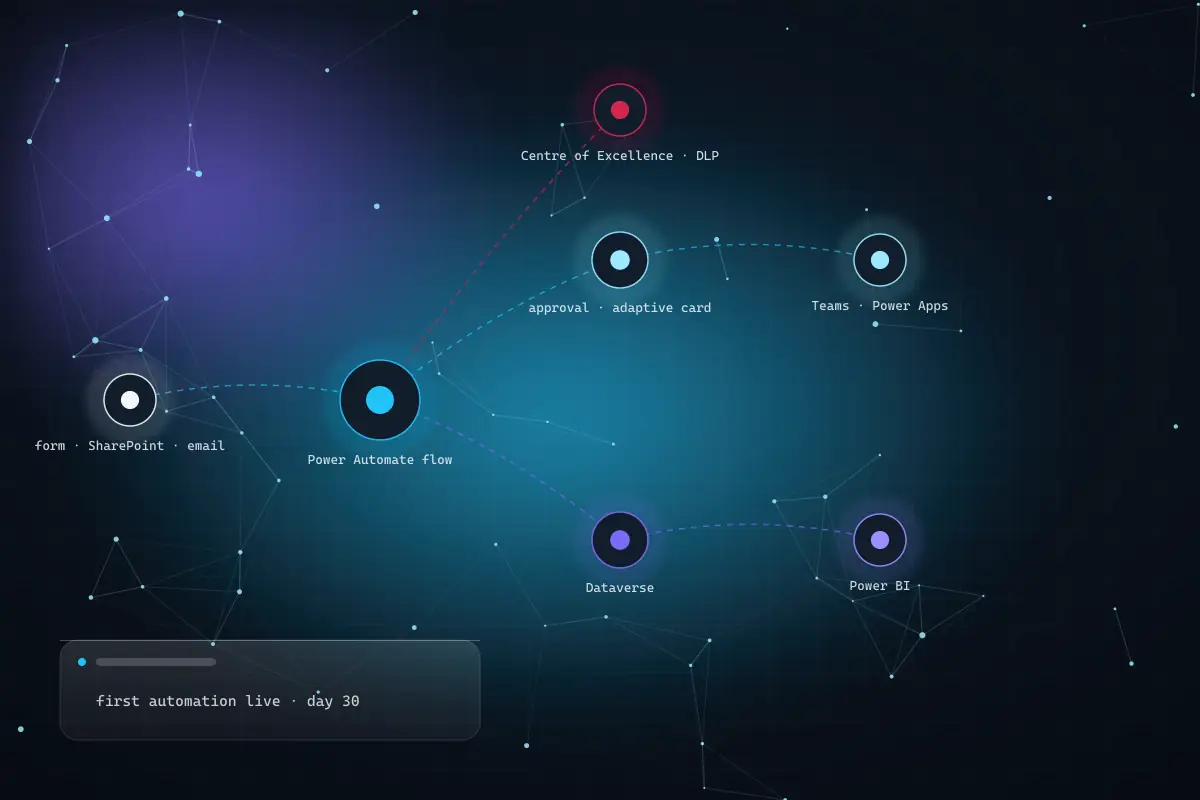
Eight hand-offs, or one governed Power Platform flow.
The same approval process, with the chasing removed and a Centre of Excellence around it. Hover any node to see the stack and protocols behind it, then step through a simulated run in the execution console, including the one where the agent stops and hands over.
Live simulated flow and agent execution
An approval flow with Dataverse and a Teams adaptive card, a connector failure that retries and a DLP block that holds, and a Copilot Studio agent that stops and hands to a person because the request is outside its scope.
The Power Platform, component by component.
Most engagements use three of these six. The free automation audit decides which, and the proposal prices only those.
- 01
Power Apps Development
Canvas and model-driven apps replacing the spreadsheets and paper forms your operation actually runs on. Built mobile-first where the work happens on a phone, and embedded in Teams so there is no new login to adopt. Typical first build: 3 to 5 weeks.
- Canvas apps for field, frontline and inspection work
- Model-driven apps over Dataverse for case and record management
- Offline-capable mobile apps with sync when signal returns
- 02
Power Automate Workflow Automation
The workflow engine that removes the chasing. Approvals, document routing, system-to-system sync and scheduled jobs that run whether or not anyone remembers. Typical first build: 2 to 4 weeks, replacing email approvals and manual rekeying.
- Multi-stage approval chains with escalation and audit trail
- Connectors into SAP, Salesforce, Xero, SQL and custom APIs
- RPA desktop flows for legacy systems with no API
- 03
Power BI Reporting & Semantic Models
Reporting that stops being a person’s Monday. Semantic models built properly so numbers reconcile, with row-level security so the right people see the right figures. Typical first build: 3 to 6 weeks.
- Star schemas and semantic models that survive scrutiny
- Row-level security aligned to your org structure
- Automated refresh, alerting and Teams-embedded report packs
- 04
Copilot Studio Agents
Conversational agents over your own data and processes: raising a request, checking a status, answering a policy question, without opening the app at all. Evaluated and grounding-checked before anyone relies on them. Typical first build: 3 to 5 weeks.
- Grounded in SharePoint, Dataverse and your systems
- Actions that write back through Power Automate, not just retrieve
- Deployed into Teams, your intranet or a website with a human hand-off
- 05
Dataverse Data Modelling
The data layer that stops app number four from becoming a fresh silo. Proper relational modelling, security roles and one version of each record. Typical first build: 2 to 4 weeks, replacing SharePoint lists used as databases.
- Relational modelling with enforced referential integrity
- Security roles, business units and field-level permissions
- Business rules and server-side logic that hold everywhere
- 06
Centre of Excellence Governance
The part most partners skip. Environment strategy, DLP policies, ALM pipelines, an app inventory with named owners and maker enablement, built into the first engagement, because setting it up at the start costs a fraction of remediating the sprawl later.
- Dev, test and production separation with promotion paths
- DLP policies enforced, not requested; solution-based ALM with source control
- Licensing review of premium connectors and capacity before the bill arrives
What we are usually asked to fix first, by vertical.
Real processes from finance, field operations and the public sector. Each one is measured against the baseline taken in Sprint 0, and each has a number attached that someone cares about.
01 · problem statement
Financial services
Purchase requisitions and multi-tier approvals running over email, invoice coding and expense claims rekeyed by hand, a month-end reporting pack assembled by a person, and an audit trail reconstructed from a mailbox at year end.
02 · deployed architecture
A Power Apps requisition form over Dataverse that validates as it is typed, a Power Automate approval chain with delegation, thresholds and automatic escalation, a direct write-back to the finance system, and a Power BI month-end pack that assembles itself overnight.
- Power Apps
- Power Automate
- Dataverse
- Power BI
- SAP · Xero connectors
03 · what we measure
- Approval cycle time
- days per request
- median and worst case, before and after
- Manual rekeying
- steps per request
- counted end to end in Sprint 0
- Month-end assembly
- hours per month-end
- people-hours on the reporting pack
We publish the metrics we baseline and report against, not headline percentages. Results are measured in your tenant against the Sprint 0 baseline and reported each sprint, including the sprints where a number did not move.
What the manual process is costing you.
Your inputs, our arithmetic. Move the sliders to the numbers you believe, and treat the result as a hypothesis the audit replaces with measured figures from your own tenant.
your estimate · per year
Estimated value of recoverable hours per year
- Hours recoverable per year
- 1,987
- FTE-equivalent capacity
- 1.2
Assumes 46 working weeks and 1,700 productive hours per FTE. Power Platform licensing and capacity bill from Microsoft to your own tenant and are not included. This calculator publishes the arithmetic; it does not forecast your outcome. The audit replaces it with measured numbers from your own process.
Check this against your real processThree ways to work with us.
Fixed price per sprint, quoted after the free automation audit. Stop whenever it stops paying.
- Start here · free01
Automation audit
Forty-five minutes, one process mapped end to end, with a build estimate and a payback figure rather than a range. Yours to keep. No obligation, no follow-up sequence, and an honest answer if the process should be fixed rather than automated.
- Commitment
- None
- Turnaround
- 45 minutes
- You receive
- Process map + payback
- Fixed-price project02
Foundations + first automation
Sprints 0 to 2. Governance baseline, Dataverse model, environment strategy, DLP and ALM pipeline, then your highest-return process live in production by day 30. Fixed price against the approved roadmap.
- Priced
- After the audit
- Production
- Day 30
- Suits
- Proving it once
- Retainer03
Sprints or retainer, monthly
Continue in two-week sprints with your team pairing on the build, or move to a care retainer covering governance, support and new builds each quarter. Capability transfer is the goal, not dependency.
- Term
- Monthly, stop any time
- Covers
- Governance · support · builds
- Suits
- A growing app estate
The sprint price is driven by process complexity and how much data modelling is needed, which is why we quote after the audit rather than guessing before it. Premium connector and capacity licensing bills from Microsoft to your tenant and is reviewed with you before you commit. Where you qualify, Microsoft MCI and ECIF partner funding may cover part of the work.
What clients say about our Power Platform work.
Feedback from teams who now build on a governed Power Platform estate, and the operating change on a typical approval process.
“We had citizen developers building apps with no oversight. Congnivex gave us a governance model without killing the momentum.”
Before & after: a typical approval process
- Request intake
- A form that validates as it is typed
- bad requests never enter the chain
- Routing & escalation
- Routed by rule, escalated on delay
- the delay is recorded, not forgotten
- System of record
- Written straight to the ERP
- the rekeying step disappears
- Audit trail
- Every action logged: actor, timestamp, decision
- year-end audit stops being a mailbox search
Illustrates the operating change on a typical purchase-approval rebuild, not a client’s figures. Measured outcomes are reported against your own Sprint 0 baseline.
Verification & alignment
- Microsoft Solutions Partner — Digital & App Innovationpartner
Designation earned on measured delivery performance and certified staff across Power Platform and Azure.
- Microsoft Solutions Partner — Modern Workpartner
Co-sell partner; eligible projects may be part-funded through MCI and ECIF.
- ISO/IEC 27001 · Essential Eightcompliance
Environment strategy, DLP and access controls aligned to both where they apply to you, documented in the CoE.
- Privacy Act · DPDP Act 2023 · DIFC/ADGMcompliance
Dataverse residency in Australia, India or UAE regions; connector policy keeps business data inside approved services.
- Governance built into Sprint 1practice
Environment strategy, DLP and ALM before the first app ships, never sold back to you afterwards.
- Your tenant, your solutions, your makerspractice
Solution-based ALM in your source control; documentation and pairing so your team can carry it.
Power Platform consulting, answered.
The questions we are asked in almost every first call, including the one about cost, answered as directly as they can be before we have seen your process.
The automation audit is free. Foundations plus your first production automation is quoted as a fixed price against the approved roadmap, driven by process complexity and how much data modelling is needed. Continuing sprints and care retainers are monthly and tiered by scope. Every sprint is fixed-price, so you know the cost before it starts and can stop whenever it stops paying. The audit gives you the build estimate and payback figure in writing before you decide anything.
A first production app typically takes 3 to 5 weeks, including the Dataverse model and governance baseline underneath it. A Power Automate flow replacing an email approval chain is often live in 2 to 4 weeks, and a Power BI pack in 3 to 6. Our sprint model puts something real in your tenant every two weeks rather than holding everything for a single launch: Sprint 0 maps and prioritises, Sprint 1 lays the foundations, and Sprint 2 releases the highest-return process to a pilot group by day 30.
SharePoint lists are genuinely fine for a single simple app with modest volume and no relational structure. Dataverse becomes necessary once you need relationships between records, row-level security, server-side business rules, or more than a couple of thousand rows with concurrent writes. It is fine for one app and structurally fatal by the fourth. We will tell you honestly which one your case needs, because recommending Dataverse where a list would do is a common way to inflate a quote.
Many builds run entirely on the Power Apps and Power Automate capability included with Microsoft 365. Premium licensing is triggered by specific things: Dataverse, premium connectors such as SQL or Salesforce, and RPA desktop flows. We map the licensing implications during the audit and tell you the cost before you commit, because discovering premium licensing after a build is a genuinely bad surprise. Licensing bills from Microsoft to your own tenant and is never resold through us.
A Centre of Excellence is the governance layer around citizen development: environment strategy separating dev, test and production, DLP policies controlling which connectors can touch business data, ALM pipelines for solution-based deployment, an inventory of every app and flow with a named owner and review date, and enablement for your makers. It is what keeps rapid app development from turning into hundreds of unmanaged, unowned apps within two years. We build it into Sprint 1 rather than selling it back to you afterwards.
That is a common starting point, and the first engagement becomes a remediation one. We inventory every app and flow, identify owners, find the ones running under departed users’ accounts, retire what is unused, and bring what is left under ALM and DLP. It is less satisfying than building something new, and it is usually the higher-return piece of work. If your own team has the capacity to carry it afterwards, we will say so and step back to a light advisory retainer rather than quoting for work you do not need.
Reviewed 6 September 2026 by the Congnivex Systems Microsoft practice · Next review March 2027